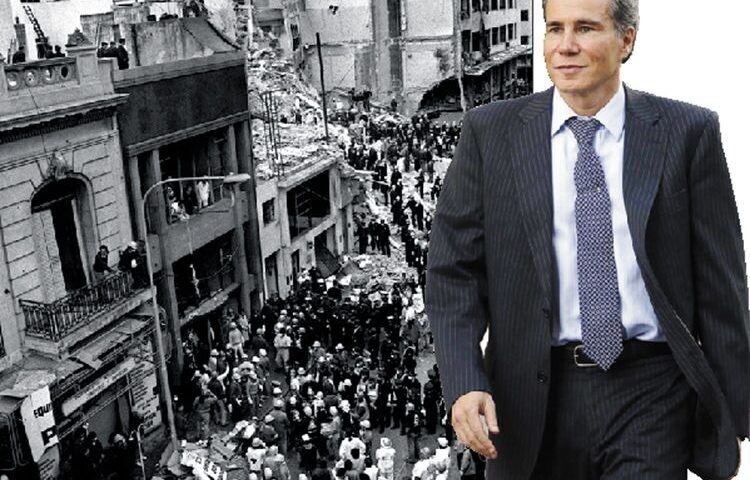
It is recognized that for decades, the main political responsible for the machinery that the Argentine justice system identified as decisive and promoter of terror remained untouched, protected by borders, power and silences. At this hour, the death of Ali Khamenei has been confirmed by the United States and Israel but not officially by Tehran. And for the relatives of the victims, for a wounded community and for a society that has seen governments, judges and promises pass, that news touches a very deep nerve. In Buenos Aires, the facts have names and dates that no one should relativize. The agreement never came into force, but it left an institutional wound: the idea that the Argentine state could negotiate, as equals, with the same power accused of being responsible for the deaths of Argentines. That discussion exploded with force when the prosecutor in charge of the investigation, Alberto Nisman, denounced that there was a plan to cover up the Iranian suspects. If the Iranian regime was—as determined by the justice—the decider of the massacre, Argentine politics had, at different moments, temptations to negotiate with that truth, to accommodate it, to 'manage' it according to miserable conveniences. The death of a leader does not replace a trial. Two attacks that changed the country's history and exposed an institutional fragility that still hurts: intelligence failures, liberated zones, cover-ups, contaminated clues and a chain of impunity that spread like a stain. Over the years, the judicial investigation raised a serious and sustained accusation: Iran as the decider and Hezbollah as the executor. The historical suspicion about the role of an Iranian diplomatic structure as a support platform in Buenos Aires never ceased to be a sensitive point: because when terrorism relies on state cover, the border between 'embassy' and 'operation' becomes a dangerous line. But if the external axis explains who planned and who executed, the internal axis explains why Argentina took so long to approach the truth. By Daniel Romero. Buenos Aires - February 28, 2026 - Total News Agency - TNA. On the same day that Israel affirms having eliminated Ayatollah Ali Khamenei—the highest figure of the Iranian system since 1989—Argentina lets in a feeling difficult to say out loud but impossible to ignore: something like a belated justice for a country that still walks with two open scars, the attack on the Israeli Embassy in 1992 and the AMIA massacre in 1994. And there appears the darkest chapter of local politics: the attempt to close the case through the back door. It is not about celebrating the war or confusing revenge with the rule of law. That conclusion was ratified in institutional terms by the Federal Chamber of Criminal Cassation, which in 2024 again attributed responsibility to the Iranian state in both attacks and characterized the attack on the AMIA as a fact of maximum gravity, in a case traversed by decades of sabotage and deviations. In fact, for the Jewish community and for the judicial system, it was the opposite: a maneuver to dilute responsibilities, shift the focus and give diplomatic oxygen to a regime accused of having planned the slaughter. For years, the hypothesis of suicide was tried to be installed, but the Argentine justice ended up reaffirming, with the weight of expert reports and opinions, that it was a homicide. In parallel, INTERPOL upheld the validity of the red notices requested by Argentina to arrest Iranian suspects, a key point because it confirms that the accusations were not a local whim but a judicial construction with international backing. On that map, concrete names appear. But sometimes history produces an event that works as a symbol: absolute power can also fall. And although there are still no firm convictions indicating who ordered and executed, the political message is unbearable: the prosecutor who accused an external power and an internal leadership ended up silenced at the most critical moment of his denunciation. That is why, when today the world talks about the death of Khamenei, the debate in Argentina should not be limited to geopolitics. And that symbol, in a country with a wounded memory, can be the fulcrum to demand what corresponds: that the responsible—the external and the internal—stop hiding behind bureaucracy, pacts and impunity. The question that the country owes itself for more than 40 years should return, with crudeness: why did the justice for the 114 dead have to wait so long, and how many times was it tried to be turned off from within? It does not bring back the dead, it does not repair the wounded, it does not rebuild broken families. But even on that plane the message is forceful: for the first time, the apex of the regime responsible for planning the attack against the AMIA is left under the shadow of a terminal outcome. The Memorandum of Understanding with Iran, promoted in 2013 during the government of Cristina Fernández de Kirchner, was presented as a way to unblock the investigation. On March 17, 1992, a car bomb destroyed the Israeli Embassy and left 29 dead and hundreds injured. A few days later, in January 2015, Nisman was found dead in his apartment. On July 18, 1994, another attack pulverized the AMIA headquarters and killed 85 people, in addition to causing more than 300 injured. Among the accused or pointed out at different stages are figures from the Iranian security apparatus and its external network: Ahmad Vahidi—mentioned by the Argentine justice as one of the central accused and later promoted in the Iranian political-military structure—; the former cultural attaché Mohsen Rabbani, the former intelligence minister Ali Fallahian, and other officials and operatives linked to the gear that, according to the investigation, connected planning, logistics and execution. In total, 114 lives cut short in the heart of the capital.